OKRs (Objectives and Key Results)
OKRs are a goal-setting framework that connects your ambitious objectives to measurable outcomes. The "O" is what you want to achieve—something qualitative and inspiring. The "KRs" are how you'll measure whether you got there—specific, quantifiable results.
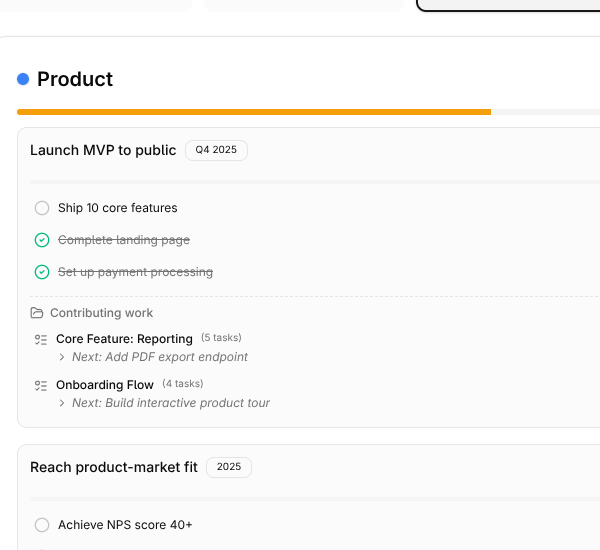
This framework, popularized by Intel and Google, works because it forces clarity. Vague goals like "get healthier" become concrete: "Run 3 times per week for 12 weeks" or "Complete a 5K under 30 minutes." You know exactly what success looks like.
The power of measurable goals
Research shows that specific, measurable goals are significantly more likely to be achieved than vague intentions. OKRs take advantage of this by forcing you to define what success actually means.
Understanding the O and the KRs
Objectives: The Inspiring What
An objective is a clear statement of what you want to achieve. It should be ambitious enough to motivate you, but not so outlandish that you don't take it seriously.
Good objectives are:
- Qualitative - They describe a desired state, not a number
- Memorable - You can hold them in your head
- Directional - They point you toward something better
Examples of strong objectives:
- "Launch a successful side business"
- "Achieve peak physical fitness"
- "Deepen my connection with family"
- "Become confident in public speaking"
Notice how these paint a picture without specifying exactly how you'll measure success. That's what key results are for.
Key Results: The Measurable How
Key results are the specific, measurable outcomes that tell you whether you've achieved your objective. They're the evidence that you succeeded.
Good key results are:
- Quantifiable - They have a number you can track
- Outcome-focused - They measure results, not activities
- Ambitious but achievable - Stretch goals, not fantasies
For the objective "Launch a successful side business," key results might be:
- "Generate $5,000 in revenue"
- "Acquire 100 paying customers"
- "Achieve 4.5+ star average rating"
For "Achieve peak physical fitness":
- "Run 5K in under 25 minutes"
- "Complete 30 pushups without stopping"
- "Exercise 4 times per week for 12 weeks"
Activities vs. Outcomes
A common mistake is setting key results that measure activities instead of outcomes. "Write 10 blog posts" is an activity. "Generate 1,000 newsletter subscribers from blog content" is an outcome. The outcome tells you whether the activity actually worked.
Setting Up OKRs in LifeGrid
Navigate to Strategy and select a life area. Each OKR lives within a life area, ensuring your goals are balanced across what matters.
Create a new objective with an inspiring, clear statement. Then add 2-4 key results—enough to capture what success means, but not so many that you lose focus.
Set a timeframe. Quarterly OKRs are the standard for a reason: 3 months is long enough to make meaningful progress but short enough to maintain urgency. You can also set annual OKRs for bigger visions, with quarterly ones feeding into them.
Linking to Projects
OKRs become actionable when you connect them to your tactical work. A key result like "Acquire 100 paying customers" might be supported by projects like:
- "Build landing page"
- "Launch referral program"
- "Run Facebook ad campaign"
In LifeGrid, you can link projects to OKRs. This connection helps you see how your daily work ladders up to your big goals. When you complete tasks within a project, you're making progress toward a key result, which advances an objective, which supports a life area.
The Quarterly Rhythm
OKRs work best with a regular cadence:
Start of quarter: Set your OKRs. Pick 2-3 objectives with 2-4 key results each. Be ambitious but realistic. Write them down and put them somewhere visible.
Weekly: Check in during your weekly review. Are you making progress on your key results? Are your projects and tasks aligned with what matters? This keeps OKRs alive rather than forgotten until quarter-end.
Mid-quarter: Do a more substantial check-in. Are your OKRs still relevant? Have circumstances changed? It's okay to adjust—better to have meaningful OKRs than to stubbornly pursue outdated ones.
End of quarter: Score your OKRs, reflect on what worked and what didn't, and set new ones for the next quarter.
Don't set and forget
The biggest OKR failure mode is setting them in January and never looking at them again until December. OKRs need regular attention—at minimum, a weekly glance and a monthly review.
The 70% Rule
Here's something counterintuitive about OKRs: you're not supposed to hit 100%.
If you achieve all your key results every quarter, you're sandbagging. Your goals aren't ambitious enough. You're leaving growth on the table.
The target is around 70%. Hit most of your key results, miss a few.
| Average Score | What It Means |
|---|---|
| 0.0-0.4 | Too ambitious, or poor execution—recalibrate |
| 0.5-0.6 | Made progress but fell significantly short |
| 0.7 | The sweet spot—challenging goals, mostly achieved |
| 0.8-0.9 | Strong quarter, but maybe aim higher next time |
| 1.0 | Your goals weren't ambitious enough |
This feels wrong at first. We're trained to set achievable goals and then achieve them. But achievable goals don't stretch you. The best goals are ones where you're genuinely uncertain—where 70% would represent real growth and 100% would represent an exceptional quarter.
100% is a warning sign
Consistently hitting 100% feels good but means you're not challenging yourself. If you always achieve everything, you're playing it safe. Raise the bar until hitting 70% feels like a genuine accomplishment.
Scoring OKRs
At the end of each quarter, score each key result on a scale from 0 to 1. Average the scores across key results to get an objective score.
Scoring isn't about judgment—it's about learning. A low score isn't failure; it's data. Maybe the key result was too ambitious, or maybe you didn't prioritize it enough, or maybe circumstances changed. Use the score to inform next quarter's goals.
Common OKR Mistakes
Measuring Activities Instead of Outcomes
| Activity (weak) | Outcome (strong) |
|---|---|
| Write 12 blog posts | Generate 500 subscribers from blog |
| Exercise 5x per week | Run 5K in under 25 minutes |
| Read 20 books | Apply 3 new concepts from reading |
| Make 50 sales calls | Close 5 new clients |
Activities might contribute to outcomes, but they're not the same thing. Focus on what you're trying to achieve, not just what you're doing.
Too Many OKRs
If you have 10 objectives with 5 key results each, you don't have OKRs—you have a wish list. Limit yourself to 2-3 objectives per quarter. Constraint forces prioritization.
No Connection to Daily Work
OKRs that exist only in a document somewhere, disconnected from your actual tasks and projects, are useless. In LifeGrid, the hierarchy matters: life areas → OKRs → projects → tasks. Make sure the connections exist.
Setting Them Alone
Personal OKRs are, well, personal. But that doesn't mean you should set them in isolation. Share your objectives with someone who can hold you accountable—a partner, friend, coach, or mastermind group. External accountability dramatically increases follow-through.
Start small
If OKRs feel overwhelming, start with just one objective and 2-3 key results for your most important life area. Get comfortable with the rhythm before expanding.
OKRs and the Bigger Picture
OKRs bridge the gap between your long-term vision (life areas) and your daily actions (tasks). They answer the question: "Given everything I care about, what should I focus on this quarter to make meaningful progress?"
Without OKRs, it's easy to stay busy without making progress on what matters. You complete tasks, finish projects, but at year's end, you're not sure what you actually accomplished.
With OKRs, you have clarity. You know what success looks like this quarter. You can evaluate whether your projects and tasks are contributing to that success. And when the quarter ends, you have concrete evidence of your progress—not just a vague sense that you worked hard.
That's the real power of OKRs: they make your progress visible, both to yourself and to anyone you choose to share them with.