Life Areas
Life areas are the foundational categories that define what matters to you. While tasks and projects come and go, life areas are permanent—they represent the ongoing domains of your life that need consistent attention: Career, Health, Relationships, Finances, Personal Growth, and whatever else you choose.
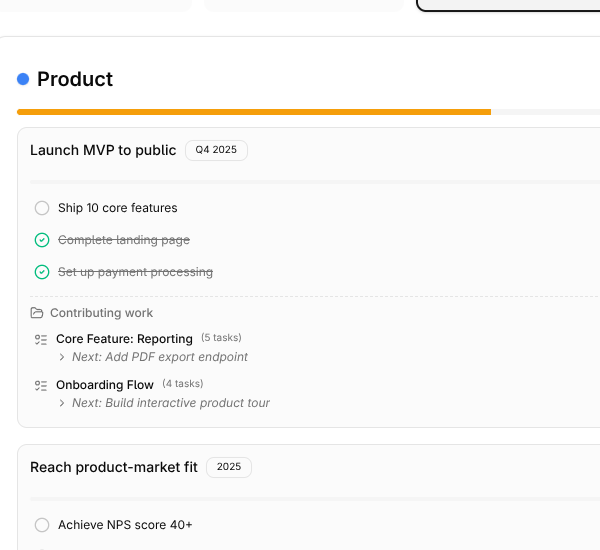
Think of life areas as the "why" behind everything you do in LifeGrid. Every project you create belongs to a life area. This connection ensures your daily work isn't just busywork—it's actually moving you forward in the areas that matter most.
The helicopter view
When you're drowning in tasks, zoom out to your life areas. They remind you what you're actually working toward and help you make better decisions about where to focus.
Choosing Your Life Areas
Most people start with 4-6 life areas. Fewer than that and you're probably missing something important; more and you're likely over-complicating things.
Here are common ones to consider:
Career covers your work, professional development, and business. If you're an employee, this might include your job performance and career growth. If you're an entrepreneur, it's your business and professional brand.
Health includes physical fitness, nutrition, sleep, mental wellness, and medical care. This is often the first area people neglect when things get busy—and the one they most regret neglecting.
Relationships encompasses family, friends, romantic partner, and community. The people who matter to you deserve intentional attention, not just the time left over after work.
Finances covers saving, investing, budgeting, and debt management. Money isn't everything, but financial stress bleeds into every other area.
Personal Growth includes learning, hobbies, creativity, spirituality, and self-development. This is where you invest in becoming who you want to be.
Home covers your living space—maintenance, organization, improvements. A well-maintained home supports everything else.
These are just examples. Your life areas should resonate with you personally. "Side Hustle" might be separate from "Career." "Kids" might be distinct from "Relationships." Make them yours.
Don't overthink it
Your first attempt doesn't need to be perfect. Start with what feels right and adjust as you learn. Most people refine their areas after a few weeks of use. The categories are tools, not commitments.
Finding Your Life Areas
If you're not sure what your life areas should be, try these three exercises:
The Deathbed Test
Imagine you're 80 years old, looking back at your life. What areas would you most regret neglecting?
Not "what would look impressive on a resume." Not "what would my parents be proud of." What would actually matter to you at the end?
For most people, relationships and health rise to the top here. Career often drops. Money becomes "enough" rather than "more." This test cuts through what feels urgent right now and gets to what's actually important.
The Energy Audit
Look at where your energy currently goes. Not where you wish it went—where it actually goes.
If you tracked your time for the last month, what would the pie chart look like? Work is probably a huge slice. What else is there? What's missing entirely?
This isn't about judgment. It's about awareness. You can't fix a drift you can't see.
The Gap Analysis
Compare the first two exercises. What matters most to you (deathbed test) versus where your energy actually goes (energy audit).
Where are the gaps?
The gaps tell you where the system needs to do the most work. If health matters enormously in the abstract but gets almost no structured attention in practice, that's your signal.
The exercise that changes everything
Spend 15 minutes with these three questions. Most people have never explicitly compared what matters to them versus where their time actually goes. That comparison alone can be transformative.
Setting Up Your Areas
Navigate to Strategy in the main menu to manage your life areas. Creating one is simple—give it a name and you're done.
A few naming tips:
Use nouns, not verbs. "Health" works better than "Get Healthy." The area is the domain; your goals and projects within it are the actions.
Keep names short. One or two words is ideal. You'll see these everywhere in the interface.
Make them distinct. Each area should be clearly different from the others. If you're not sure whether a project belongs in Area A or Area B, your areas might be overlapping.
How Life Areas Connect to Everything Else
Life areas sit at the top of LifeGrid's hierarchy. Here's how they connect down:
OKRs live within life areas. When you set a quarterly objective like "Launch my side business," it belongs to a life area (probably Career or a dedicated Side Hustle area). This ensures your big goals are balanced across what matters.
Projects belong to life areas too. "Launch personal website" might live under Career. "Plan summer vacation" under Relationships. Every project has a home.
Tasks inherit their project's life area. When you're working on a task, you can see which life area it ultimately serves—even if you're just focused on the immediate work.
This hierarchy isn't bureaucracy—it's clarity. When you complete a task, you're not just checking a box. You're advancing a project, which supports a life area, which represents something you deeply care about.
Maintaining Balance
The whole point of defining life areas is to maintain balance. It's easy to let work dominate while health and relationships wither. Life areas make this visible.
The Check-In
During your weekly review, glance at your life areas. For each one, ask:
- Is there at least one active project here?
- Have I done any work in this area this week?
- Is this area getting what it needs?
If a life area has gone quiet for a few weeks, that's a signal. Either it genuinely needs less attention right now (that's okay—see "Intentional Imbalance" below), or you've drifted and need to course-correct.
Intentional Imbalance
Perfect balance is a myth. Life has seasons, and sometimes one area legitimately needs more focus:
- Starting a business? Career will dominate for a while.
- New baby? Relationships and Health take priority.
- Health crisis? Everything else takes a back seat.
The key is choosing the imbalance rather than drifting into it. When you consciously decide to focus heavily on one area for a period, you can also decide when to rebalance. Unconscious imbalance is how people wake up years later wondering where their health or relationships went.
The drift is subtle
Nobody decides to neglect their health or relationships. It happens gradually—a few skipped workouts, a few postponed dinners with friends. Life areas help you catch the drift before it becomes a crisis.
Reviewing and Adjusting
Life areas aren't static. As your life evolves, your areas might too.
When to adjust:
- A major life change (new job, new relationship, moving)
- Something feels off—an area is too broad or too narrow
- You keep putting projects in the wrong area
How to adjust:
- Rename an area if the label no longer fits
- Split an area if it's gotten too big
- Merge areas if they've become redundant
- Archive an area if it's no longer relevant (rare, but possible)
Quarterly is a good cadence for reviewing whether your life areas still make sense. But don't tinker constantly—the value is in stability, not endless reorganization.
Life Areas vs. Goals
A common question: "Isn't 'Health' a goal?" Not quite. Here's the distinction:
Life areas are ongoing. You never "complete" Health. It's a permanent domain that requires continuous attention.
Goals have endpoints. "Run a marathon" has a finish line. "Lose 20 pounds" has a target. These are objectives or projects within the Health life area, not life areas themselves.
This distinction matters because it changes how you think about progress. You don't "achieve" Health and move on—you maintain and develop it forever. But within Health, you set specific goals, complete them, and set new ones.
Life areas provide perspective
When you're stressed about a missed workout, zoom out. One missed workout doesn't ruin your Health life area. What matters is the pattern over months and years. Life areas encourage this long-term view.