Daily Planning
The Daily Focus view is where you spend most of your time in LifeGrid. It shows exactly what you've committed to today—nothing more, nothing less. No overwhelming backlog, no distant future tasks, just today's work.
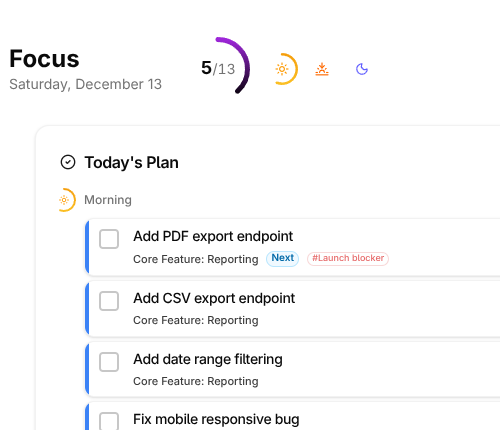
This focused view is intentional. When you open Daily Focus, you're not deciding what to do—you've already decided that during planning. Now you just execute. This separation of planning from doing is surprisingly powerful. It frees your morning brain from making choices and lets you dive straight into action.
The power of constraint
Seeing only today's tasks isn't a limitation—it's a feature. A short, curated list is far more actionable than a sprawling backlog. You'll actually get things done instead of staring at an overwhelming list.
Your Morning Routine
When you open Daily Focus each morning, take a moment to review what's planned. Does it still make sense given how you feel and what's come up? Maybe yesterday's energy-intensive task should move to tomorrow when you're fresher. Maybe something urgent appeared overnight.
This isn't re-planning—it's a quick sanity check. Five minutes max. Then start working.
If your list looks right, pick the most important task and begin. There's something satisfying about checking off that first item before you've even finished your coffee.
The MIT: Your Day's Anchor
The Most Important Task isn't just a concept—it's a practice that changes everything about how your day feels.
Every day has one task that, if completed, would make the day a success. Not the most urgent. Not the easiest. The most important. Identify it. Do it first.
How to Identify Your MIT
Ask yourself: "If I could only complete one thing today, what would make me feel like the day wasn't wasted?"
Your MIT usually:
- Isn't the most urgent thing
- Is the most impactful thing
- Is often the task you're tempted to postpone
- Creates the most progress toward your goals
Sometimes the MIT is a single big task. Sometimes it's a small task that's been hanging over you for weeks—five minutes of work that removes a weight you've been carrying.
The MIT Ritual
Do it first. Before email. Before Slack. Before meetings eat your focus. Your energy and attention are highest at the start of the day. Most people waste this peak time on low-value activities—checking news, scrolling feeds, responding to emails that could wait. By the time they get to important work, they're already depleted.
Flip it. Do the important work when you're fresh.
Protect the time. Block your first 2-3 hours for MIT work if you can. No meetings before 10am. Email and Slack closed. Phone in another room. Just you and the most important thing.
Accept that it might take all morning. Some days, the MIT takes 30 minutes. Some days it takes 4 hours. Either way, once it's done, the day is already a win. Everything else is a bonus.
The power of first
Something changes when you do important work first. Even if the rest of the day falls apart—and some days it will—you've already moved the needle on something that matters. That changes how you feel about the day, and over time, how you feel about your life.
Working Through Your Day
As you complete tasks, check them off. Watch your list shrink. There's a primal satisfaction in this—your brain rewards completion, and that little dopamine hit motivates you to keep going.
If you finish early, you can pull in more tasks from your weekly plan. But don't feel obligated to fill every minute. Finishing your planned tasks early is a win, not an invitation to overload yourself.
If something takes longer than expected, don't panic. Move it to tomorrow or back to the weekly pool. The goal isn't to complete everything you planned—it's to make consistent progress on what matters while maintaining a sustainable pace.
Handling Interruptions
Interruptions happen. Someone needs something urgent. A meeting runs long. An unexpected problem demands attention.
When interrupted, make a quick decision:
- Is this truly urgent? If yes, handle it. Your plan can flex.
- Can it wait until tomorrow? Add it to your inbox for later processing.
- Is it someone else's emergency? Be thoughtful about whether it's really your problem.
After handling the interruption, return to your plan. The structure is there to help you recover, not to make you feel guilty.
Matching Tasks to Energy
Not all hours are equal. You probably have times when you're sharp and focused, and times when you're running on fumes. Plan accordingly.
High-energy blocks (often morning for most people) are for deep work: complex thinking, creative tasks, challenging problems. Protect these hours.
Medium-energy blocks work well for planning, communication, and tasks that require attention but not intense focus.
Low-energy blocks (often late afternoon) are fine for routine work: admin tasks, quick emails, organizing. Don't waste prime mental energy on tasks that could be done tired.
Know your chronotype
Not everyone is a morning person. If you do your best work at night, honor that. The point isn't to follow someone else's schedule—it's to match your important tasks to your best hours.
Habits in Your Daily View
Habits you've set up appear automatically when they're due. You don't need to plan them—they just show up.
Check them off as you complete them. If you miss one, don't stress. The occasional skip is normal. What matters is the pattern over time, not any single day.
See Habits for more on building and tracking recurring behaviors.
The End-of-Day Review
Before you wrap up, take two minutes to close out the day:
First, check off anything you completed that you haven't marked yet. This ensures your records are accurate and gives you a sense of closure.
Second, look at what's left. If tasks remain, decide: move to tomorrow, back to the weekly pool, or just delete if they're no longer important. Don't leave dangling tasks cluttering your view.
Third, glance at tomorrow. Do you know what you're doing? If your tomorrow is already planned (which ideally it is—see "The Night Before" below), you can close your laptop with confidence. You've done today's work. Tomorrow's plan is ready. You're free to enjoy your evening.
When to Plan: Night Before vs. Morning
Some people plan their day the night before. Others prefer to plan in the morning. Both work—choose what fits your life.
Night-before planning has advantages: you go to bed knowing tomorrow is figured out, and you wake up ready to execute. You also do your planning when you have perspective on the day, not when you're groggy and reactive.
Morning planning works too, especially if your evenings are chaotic or your days are unpredictable. Just keep it short—5 minutes to review and commit, not 30 minutes of reorganizing.
The worst approach is no planning—just opening LifeGrid and reacting to whatever seems most urgent. That's a recipe for busyness without progress.
Try both
Experiment with planning at different times. After a week of night-before planning and a week of morning planning, you'll know which one suits your rhythm better.
Common Daily Planning Mistakes
Overplanning. Scheduling more than you can realistically do leads to guilt and carryover. Aim for 3-5 important tasks, not 15.
No buffer. Things always take longer than expected, and surprises always appear. Leave 20-30% of your day unscheduled for flexibility.
Ignoring energy. Putting deep work in low-energy slots sets you up for failure. Match tasks to your natural rhythms.
Skipping the review. If you don't close out the day, you'll wake up tomorrow to a messy list. Two minutes of cleanup saves tomorrow's frustration.