Habits
Habits are the small, repeated actions that compound into big results over time. Unlike one-off tasks that you check off and forget, habits are things you want to do consistently—whether that's daily meditation, weekly meal prep, or a monthly budget review.
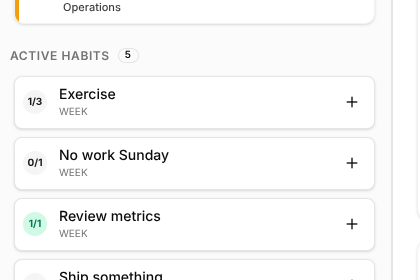
LifeGrid treats habits as first-class citizens. They appear in your daily view when they're due, track your streaks, and connect to your life areas so you can see how your daily routines support your bigger goals.
The power of consistency
A 1% improvement every day compounds to being 37 times better over a year. Small habits, done consistently, beat ambitious goals that fizzle out.
Creating Your First Habit
Head to the Tactical section to create a new habit. Give it a clear, specific name—"Morning meditation" works better than just "Meditate" because it tells you exactly when and what.
Next, choose how often you want to do it. You have a few options:
Daily habits are for things you want to do every single day. These work best for routines you're building into your morning or evening—things like journaling, taking vitamins, or a quick workout.
Weekly habits let you pick specific days. Use these for activities that need a particular slot, like "Weekly review on Sunday" or "Date night on Friday." You can also set a target like "3 times per week" if you want flexibility on which days.
Custom frequencies handle everything else: every other day, twice a month, or the first Monday of each month.
Start with one
The most common mistake is creating too many habits at once. Pick the single habit that would make the biggest difference in your life and nail that one first. You can always add more once it's solid.
How Habits Show Up in Your Day
When a habit is due, it appears automatically in your Daily Focus view alongside your tasks. There's no extra step to "plan" habits—they just show up when it's time.
Check them off as you complete them. If you don't complete a habit by the end of the day, it's marked as skipped and your streak updates accordingly. Don't stress about the occasional miss—life happens. What matters is the pattern over time.
Your habits also appear in the weekly planning view, giving you a bird's-eye view of what's coming up. This helps you plan around them rather than being surprised by a habit-heavy day.
Building Habits That Stick
The hard part isn't creating habits in LifeGrid—it's actually doing them in real life. Here are strategies that work:
Start Embarrassingly Small
Most people make their habits too ambitious. Instead of "Meditate for 30 minutes," start with "Meditate for 2 minutes." Instead of "Run 5K," start with "Put on running shoes." The goal isn't the activity itself—it's building the neural pathway of consistency.
| Ambitious (likely to fail) | Tiny (likely to stick) |
|---|---|
| Meditate 30 minutes | Meditate 2 minutes |
| Run 5K | Put on running shoes |
| Read for an hour | Read one page |
| Full workout | Do 5 pushups |
Once the tiny habit is automatic, you can gradually increase the difficulty. But only then.
Attach to Existing Triggers
New habits stick better when you anchor them to something you already do. This is called habit stacking:
- "After I pour my morning coffee, I will write in my journal"
- "After I brush my teeth at night, I will do 5 minutes of stretching"
- "After I sit down at my desk, I will review my daily plan"
The existing habit becomes your trigger. You don't have to remember to do the new habit—it's just what comes next.
Make It Obvious
Put your journal next to your coffee maker. Lay out your workout clothes the night before. Keep your vitamins by the sink. The less friction between you and the habit, the more likely you'll do it.
The Bad Day Version
Here's a concept that saves habits from dying: define a minimum version that still counts.
Your motivation, energy, and circumstances vary. Some days you're firing on all cylinders. Other days you can barely function. If your habit only works on good days, it won't survive real life.
For every habit, define two versions:
| Habit | Normal Version | Bad Day Version |
|---|---|---|
| Exercise | 45-minute workout | 10-minute walk |
| Writing | Write for 2 hours | Write one paragraph |
| Meditation | 20 minutes | 3 deep breaths |
| Reading | Read for an hour | Read one page |
| Journaling | Full reflection | 3 bullet points |
On good days, do the normal version. On bad days, do the minimum. Both count. Both keep the streak alive.
The minimum version protects your identity. You're still "someone who exercises" even on days when you barely move. You're still "someone who writes" even on days when you produce almost nothing. That identity matters more than any single day's output.
Don't break the chain... but also don't obsess
Streaks are motivating, but don't let a broken streak derail you. Missing once is an accident. Missing twice is the start of a new habit. Get back on track immediately, even if it's just the tiny version.
Tracking Your Progress
LifeGrid tracks several things automatically:
Current streak shows how many times in a row you've completed the habit. This is your main motivation metric—watching that number climb feels good.
Completion rate tells you what percentage of the time you actually do the habit. An 80% completion rate is excellent. Even 60% means you're doing the habit more often than not.
History lets you look back at your patterns. You might notice you always skip habits on Wednesdays (meeting-heavy day?) or that your streaks break around holidays. This insight helps you plan better.
When to Adjust
Habits aren't set in stone. If you find yourself dreading a habit or constantly skipping it, that's data:
- Too frequent? Switch from daily to 3x/week
- Too vague? Make it more specific
- Too hard? Make it smaller
- Not important? Delete it and focus elsewhere
There's no shame in deleting a habit that isn't working. Your energy is limited—spend it on habits that actually matter to you.
Connecting Habits to the Bigger Picture
Each habit can belong to a life area. This connection isn't just organizational—it helps you see how your daily actions support your larger goals.
Your "Morning meditation" habit might live under Personal Growth. Your "Weekly budget review" under Finance. When you look at your life areas, you can see which ones have active habits supporting them and which might need attention.
This is the magic of LifeGrid: your daily meditation isn't just a checkbox. It's a brick in the foundation of your personal growth, connected all the way up to your life's priorities.